BUILD & ALL ENTAILS
From here we start the true deconstruction, design, and resurrection of this motorcycle. What follows is a chronological order of events, simply presented before you for enjoyment, delivered with less philosophy as I plan, but I can be rather tangential, so I claim no promises. So, first examine the condition of the original tank.

You will note that it wasn’t even considered to be used in the previous firing, as it was extensively rusted inside and the petcock was stubbornly locked in place. Also, signs of past life, events, general usage, whichever you see in the large crease along the decal, along with another deep blow not pictured toward the rear. While these will eventually be dealt with, for now the focus is a small application of chemistry upon the inside. Iron oxide, rust, the accumulation of extra mass from elements within the air to the metal itself. The plan is to use acid to eat away as much, if not all of the rust, and contain joyous hopes that there is plenty of metal material left after the process. Again, be it my timidness or care, I would dare label a simple vinegar solution inside as acidic, but maybe the roommates wouldn’t dare, or care enough to disturb the process anyway.
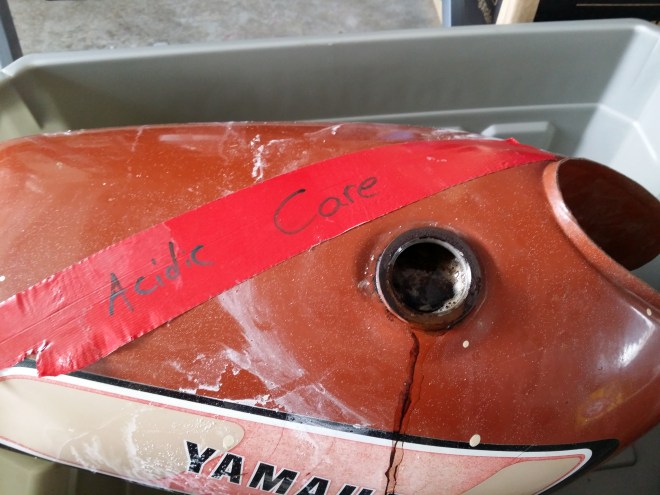
Aghast! Our first flushing revealed much more than could be anticipated, or with sheer luck our experiment is a little too successful. Although, the results will soon show for themselves, all the while during each stage the tank would hold true along all pinch weld seams. Just observe how much crud at this point was present. Appreciate too, my need to filter and reuse a nearly 5$ a gallon product to do this multiple times, all the while to later use excess far exceeding 5$, true lunacy indeed.


After this you need to promptly act to neutralize the metal surface, or soon your efforts will be in vain. A solution of water and baking soda, at what ratio I cannot recall, but simple enough to find, will do nicely for us. This is followed by a fog of oil for long storage, which would turn to be that of years over, but this tank will be dealt with soon enough. We move then to our first purchase, one of many and will be thrown in as they come as they are needed, on sale, or desired.
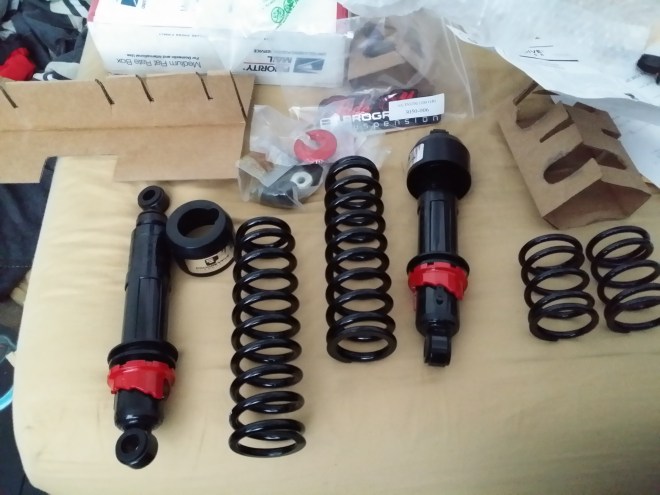
Progressive shocks, a slight improvement over the original single compound spring setup, and I had no intention of restoring the originals anyway, though they are certainly in the expansive old parts bin. I admit that I aesthetically appreciate piggy back shocks, much like that of Ohlins, but at a decent price these would do. Sadly, pictured you will see a defect in the upper plastic cover, which was actually worse than pictured and would make it unusable, either send it back to get a replacement, or accept it as is and appreciate is as it is. I’ll choose the latter, as is my forgiving and inward notions. Our next endeavor is that of small engineering concern, to ask that of Scotts technical if we might adapt one of their steering dampers for use, as there is none existing for our XT500 through this vendor, let alone one to have adapted USD forks and front end from another model. USD you ask? Upside down forks, a completely different front end adapted for our needs. Ultimately, my hope was to fabricate such a front end from another model and utilize all of its basic improvements over stock, larger stanchions, disc brake, leading axle and the like. Without much extensive design thought, in terms of finding actual measurements and applying them in practice like finding rake and trail, I was set to make good from newer Yamaha, a WR400 front end, to be had soon. Going back to the stabilizer though, this is where the question would come from, to adapt a weld on kit for the WR400 upper tree and see if there would be enough clearance for the mount.
Technical support was helpful and seemed to assure that it should work, and wouldn’t be an issue if it didn’t. So the choice would be made to pursue this route, which product we will shortly see. Next we have an examination of the gauge clusters. Moldy, rusty, weathered lettering on the outside, yet a stunningly clean and beautiful inside, on the fine internals at least.


Though this is only a dissection for now, and to be added is further new parts, new to me at least, but certainly not to Yamaha in general, but certainly new to ours.


Used auctions will be a source of some good materials for the build, though not numerous in need. Here we have a complete front brake assembly, front axle, front wheel, and by chance the speedometer cable contains the same threads for reception, and with a same 21 inch front wheel hopefully no engineering conversion fuss to be had.


Another delivery of newness, and very appealing in that respect. This Scotts unit while beautiful in its own right, is mechanically more precise than that of available sliding shock designs. Any reasonable person who doesn’t understand would shudder disapprovingly on price and necessity, and frankly that’s just fine with me, although there is a valid point to be heard there. We move forward with further examination of the bikes current state, rotted tires, rusted and fused bolts, and an application of masculine force.


Fine, all that occurred would be the removal of the rear wheel, perhaps only since I have that pictured do I even mention it, as certainly much other removal has taken place that I have omitted in the passing. Next, we have trial and error, or examination of what more needs to be done to fit a soon to be new front end.


In no way does the actual triple tree set up come close, the stem is too long by a factor of inches, it utilizes roller bearings versus that of original roller balls that explode everywhere for those who are just a little to fast to act. But, the possibility through a challenge to make it work would soon come to be, and at least we have one small victory in seeing that the mount does indeed clear the fill neck. A flurry of purchases are soon to follow. Retro yet very acceptable Excel Takasago rims, which will have wider footprint in the rear from 1.85”/2.15” and allow the use of more common metric tire sizes. A tired old pair of forks from a gracious WR400 donor, complete and lacking much irreversible blemishes. Further research would also conclude the adaptability of a hydraulic clutch, Magura Jack Hydraulic Clutch Assembly – Gen II 0120524-70 specifically, that information will save you much time and pain from looking elsewhere.


Yet more new bits, replica gauge face decals from a UK distributor if I recall, and a very appealing oversized 320mm front disk set up from EBC. Male excess in bigger, better, stronger here, of course, but there is some practical application. Also, the color contrast evokes just that much more, and strangely it would so happen that it mates up with old school colors of blue & gold.
More observation from old pieces, though actually I needed to have a rough estimate of what type of silencer I would be able to use, I needed something with a little more reflection than that of rust, hence the yard stick, however crude it may seem. Also, an overview of the hydraulic clutch where you can see how it sits in the receiver on the case, and the fact that the hose lengths are agreeable. Do take time to notice and appreciate the weathering of time, oxidation, moss, the presence of a lonely leaf, as these forms will eventually come to change greatly in due time.
If you know, the XT500 is an oil in frame style, or dry sump, so cooling really shouldn’t be an issue, but that can’t stop us from trying, and again the appreciation that comes in making one work from random assortments of pieces, together performing one simple function. A new silencer also to come, unquestionably far to large and universal in nature, but a killer deal at the time and caught my eye with something so simple as the turndown towards the end. I confess that these parts won’t see further use for years, but they do have a new home more so than that of shelving stock, only if we can create such a distinction in difference.


I’ll next just show conditions of the wheel lacing, the reasons for which was to document the lace pattern so I could rebuild them, quickly that hope would be pushed to another, actual professionals.
More new with more old. The new forks might have been okay mechanically, and certainly didn’t leak, I wasn’t going to allow myself to say that they were as good as they could be, and an opportunity to work on something I hadn’t before. Wheel disassembly, final drive gearing, and oil line ideas join this next display. While I am a pretty conservative man on the road, I can find great enjoyment in getting up to speed at far to accelerated of a rate, so in truth this gearing might actually work against this which is perhaps good, or an excuse to tempt higher top speed runs.
Small explosion of niceties. It is a known issue of higher gas flows upon higher rpm ranges for this motor, not that it is of much concern, if any for trail riding and traction, I accept that this will be a street only machine, which you can claim is a discredit to the machine if you insist that it thrives off road, then I’ll urge you to find and love one to accomplish that so this world can have both. Next is our first batch of many from a local powder coating source, Oregon Powder coating. I had used them before for my 1987 XL250R frame from a previous restoration, which I might add later, but be advised, they do good honest work at comparable rates.


Next, just a gallery pertaining to the front forks mainly, and you can observe the resolve that we even dared open them, there certainly was work to be done and improvements to be made.


More good work to follow on the gauge clusters with the application of the new face decals and a sealing of oil will ensure hopefully, ease free use. I did have to alter slightly the screws that attach the faces to their inner mechanisms, just simply tap for a slightly larger size while using an Allen head over Phillips, more on that later.


At the time all of this was occurring in a matter of weeks and I was feeling very confident in my vision by this point, though this next work would start to sharply hinder that same vigor, though certainly well worth it. I talk of the incredible work that Buchanan’s Spokes was able to do for me. All that I really had to give them was quality finished parts first of course, but the actual nipple angles, spokes, lacing, and tensions would all have to be created by them. For those who still appreciate it, such work adds such more character than something from a machine or mass assembly line, even if the result is somewhat similar.


Moving back to old, worn, and torn, we have the innards of the forks. All seals and bushings would need to be replaced after having disassembled, but an issue worth correcting would be the oil. Stinky, gritty, needlessly thick, and bound for recycling. Maybe the forks themselves enjoyed a previous life of fulfillment for another rider, which would be a great hope and soon to be new, fresh and onto a new life.


Our first milestone of the build is thus upon us, we have actually finished one entire aspect, the wheels themselves are done. Hubs rebuilt and painted, laced and trued to new matching rims, tires mounted and balanced, a well deserved sight of relief and reassurance of pride from material to man.
Huge gallery of gauge cluster work now. Painting and refurbishing of the extensively rusted and pitted bases, which would be accurate for their orientation, with draining holes blocked by small critters looking for a home to lay claim to all those years. Otherwise, as stated before the inner workings were in great shape, so painting of the inside reflector bucket was all that was needed. White was the choice for its high albedo to reflect the origin light source away, meaning the option for many different color illumination choices if so chosen later.


We finish, well almost, another aspect of the project, and will repeat the exact same process, but upon a different part with a different purpose. A rebuilding of the hydraulic brake system then, along with their painting. Black to match what will be much of the theme, but with many other pieces I will question any other finish, raw, polished, painted, and find the beauty in each, even if only one is applied.


Time for a new toy for the garage, a tool rather, but I contain a true joy in polishing, even though I still can learn quite a lot to sharpen my skills, which likely means simply, be more patient. Again seemingly meaningless to many, and really not serving any purpose, this act requires time and effort to be accomplished, it emulates the experience in the finished result.
Thus, the combination of two different processes upon the same mechanical system, with both contrast and combination that act simultaneously, fluidly.


Yet another large gallery, I’ll just let the pictures depict the work occurring upon more brake and fork components.
Soon to be completion of another aspect, the forks. These picture don’t do justice to just how much of a difference a good polish turned these forks into quite the lookers. Of course, black mudguards to complete the assembly as well, and I’ll decide later if to use white Yamaha lettering for contrast here, but it is an option.


Somewhat pointless pictures here, well perhaps most of these are, but pointless in the sense that I took great care to paint the gauge cluster shells, only to later have them powder coated. More on that later, but really no surprise if I haven’t already mentioned my disdain for painting.


For those of you who have dredged this far along, either in anticipation and interest in the whole process, or your meager scrolling has led you right here, I ask you to pause and look elsewhere for a while. Go find some enjoyment in something else for a while. Read a book, go workout, go outside, try something new, but please just go do something productive and feel well and accomplished no matter what task you so choose. Then, and only then, tension and curiosity might reach you again, subsequently allowing you to forge ahead with joy. Though to, there is metaphor here towards the process itself. What I claim is that at this point, other life necessities would cloud the ability to focus all attentions right here. I would finish all my college courses, spend complete weekends and weeknights composing my thesis, which if you are curious can be found here, https://digitalcommons.wou.edu/honors_theses/90/, which is certainly dense if you have no reference, but has parallels that those who might be familiar in such areas can find. I would continue at the time what would be my fifth year as a wildland firefighter and enjoy a short adventure in Alaska (merely 1 of 10 I have worked in, let alone driven or flown through), again for another time. Lastly, I would rebuild my one and only vehicle so far, a great, simple, reliable and desirable 1st gen 4Runner, hopeful to keep and maintain for many, many years. Lacking in all the creature comforts of any modern vehicle, but is yet another extension of myself. Perhaps too, I lost my vision for the project as a whole, where did I want it to go, what did I want it to truly become. Truth lies here sure, and bluntly, I ran out of finances to continue, I don’t incur debts like so many seem to so easily succumb to, or have patience to build enough capital to continue. Alas, here are some various measurements that someone out there might need for shocks and exhaust work tuned length and overall pipe volumes, the only work for over a year.
From here we proceed in the now, there are no more breaks, the project continues until its completion. Are there obstacles, at every turn indeed. Even at the moment of this writing the project is incomplete and will yet to be shared with all in a far too pronounced, profound and overly expressive manner. But, part of me wants that explosion to occur, or at least hopes for it, be it just friends, those who helped, or the motorcycling community. From here forward, my maturity to engineer the vision through would begin to expose itself, carefully drawing diagrams, using various tools available for all calculations that one desires, document exactly what will be needed and what was used, and catalog all the information about these bikes that is available, which I hope to share possibly in another page here. My hope is that from the first proceeding picture, to the last to occur in less than two years, leaving me just 3 months to do so from this prose formation. Where to go from here, where to start again would be to see come of the vision outright, the need to see the basic shape, size, and attitude that the machine may take. To do so, there was some cleaning to be done, perhaps the last remains of the past to be washed away. Though, the machine in whole as frame and engine, the truest remains that will stay from the origin, will change drastically, yet hardly so to a passive observer. So here we are, some of the last of the past.


One of the first additions of new and old, I believe to be the first new anything to be added to the original bike. Probably an eagerness to see something before it is needed, but coming very soon it will be the foundations of necessity. So here you are, some terribly shot dark photos of one simple, albeit so perfect, piece of tubing , our exhaust header applied.
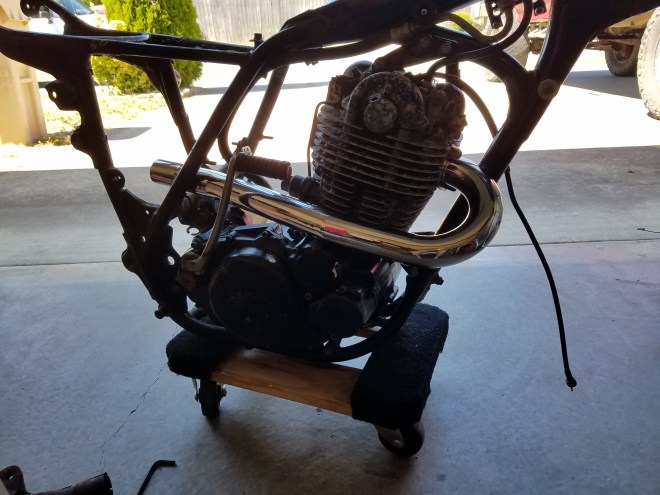
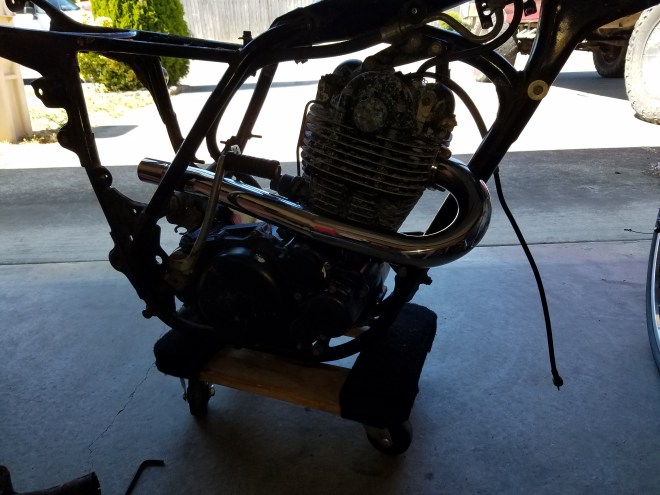
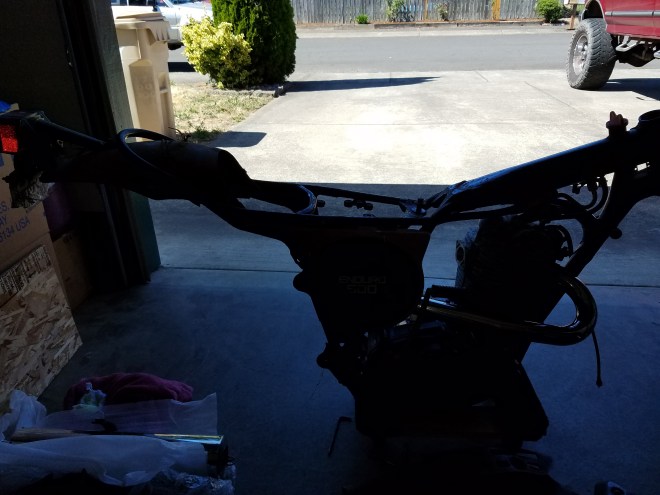
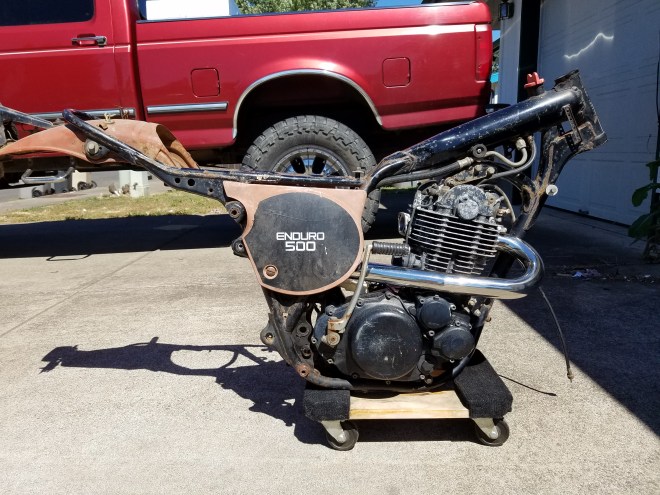
The combination of new and old yet again, just observe, and yes the horrendously excessive silencer, though not that far reaching over stock somehow.
Trust me, the front end will join us soon enough, and will crush all expectations of what this is to be, in the meantime more newish parts. Being that I was to use the WR400 front end, the trees would dictate the inability to use the original fender, which shape is actually fair for my tastes. However, any aftermarket styles available to suite were, well, atrocious for my eyes to apply here. Far to angular and alien if you are to look at them as such. Some research would lead me to try yet another Yamaha base item, an XJ700 fender, sleek, simple, and just about the right shape to follow the curvature of the wheel. There will be some fabrication to fit, but thankfully it can work.


An ordinary spring compressor in one hand, a stunning fabrication on the other.


Only as it exists did I require to attain. These are modular head fin accessories available from a Thailand individual, Omegaracer, along with other shiny bits pictured shortly but arriving together. While not overly common, some individuals will weld larger fins in the first place to aid in heat dissipation, almost exclusively for high comp track motors where gains on an early head can be had. What will occur here, however, there is the unfortunate incompatibility to use these fins on an early model head with the smaller fins, but at least we now know that and will correct, with other benefits found in doing so.
The accompanying piece, full aluminum, polished, fully assembled, elegant, swing arm. While part of me feels pathetic in holding back and not restoring the original, the contrast in color, shape, and practicality to utilize a wider rear tire were the primary factors leading the decision. While I don’t have the exact measurements on hand, the swing arm is between 1-2” longer, and the shock mounting perches are narrower by 1” total which will require a solution much later.


The subsequent joining of old and new yet again. There is, in retrospect, a sense of loss when observing these images as there is something so raw and right with the old, tattered, beaten, weathered state this machine once had, but I find comfort in knowing I took adequate time and enough care to document such things.


Useful information now, those head differences I spoke of are evident here. Though widely known that this exists, I was unable to find stark examples, so I give to you. It’s quite simple in that the fins are just larger all around, and the accessory fins wouldn’t sit on the early head. Our new head comes from an SR500, the familiar street version of our machine. I don’t claim this as fact, but I think that all SR500 heads of their early era are this manufacture, as well as containing the 2J2 stamping. What stamping? Well, another benefit to this head is the presence of 2mm over sized inlet valve at 47mm, vs the XT500 45mm inlet valve, both containing 39mm exhaust valve diameters. Our first inherent performance gain, though even this minute detail will be grossly altered later for yet more benefits.


An engineering feat plagues us now, make our new front end work with our old frame and head tube. My overall idea was to utilize the original steering stem and simply mate it through the new triple trees since we know this stem can work in the frame, and we can deal with issues from there. The first of these being that a shorter stem would move the stanchion mountings closer together, allowing virtually no height adjustment for the front, which will dictate to a degree rake, trail, and handling characteristics where one cares enough to alter such things. I suppose more on this shortly.


We are now here, the birth of something new and fantasizing on the growth that one day will bestow this machine. A vision manifested in form, now bears to light in some shade of our overall desires. The amount of thought and time taken to this point is numerous in measure, and only a tantalizing realization of how much more will come. Enjoy as you see fit, and yes judge my ineptness to frame a picture in a more artistic way, this is simply where it and I were.
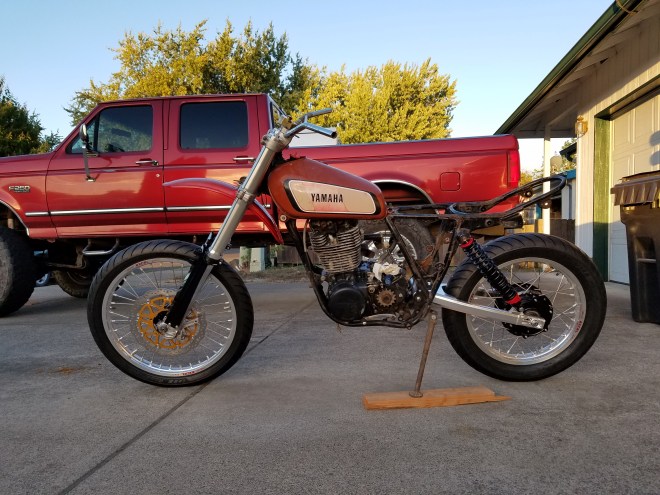
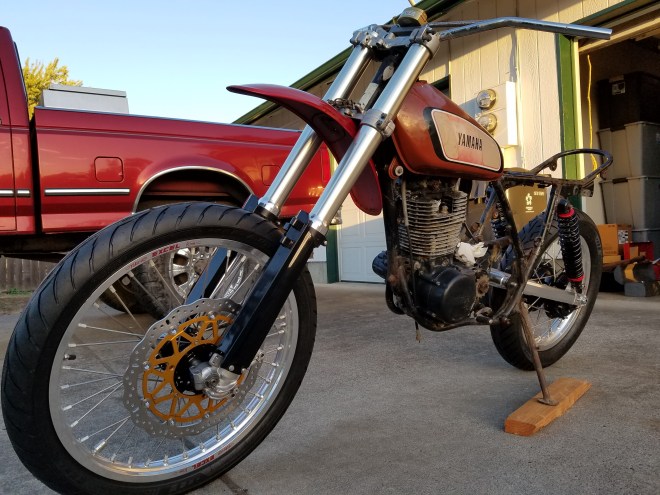
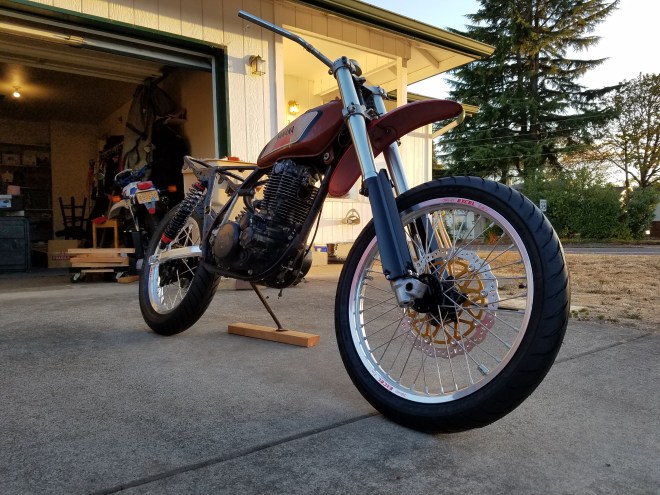

The incredibly short description that I presented pales in comparison the emotions that were present in me at the time, which I might fail to represent in writing or remembrance. However, I also wish to portray as much of the occurrence as I can of these events in as little time as I can, this is a task and it needs to be done. Even this amount of writing and presentation has occurred in a matter of 3 days, it is a task that I started and must be completed, only then will my mind rest upon this task, only to hopelessly look for another to tackle in succession. Thus, I hope you are still entertained, or intrigued to continue, though I have no influence on your own needs regardless of what words I present here, as we are all our own individual forces whose actors are ourselves, none else.
Continue below,
Further Disassembly & Engine Focus


 adventuresAvery